

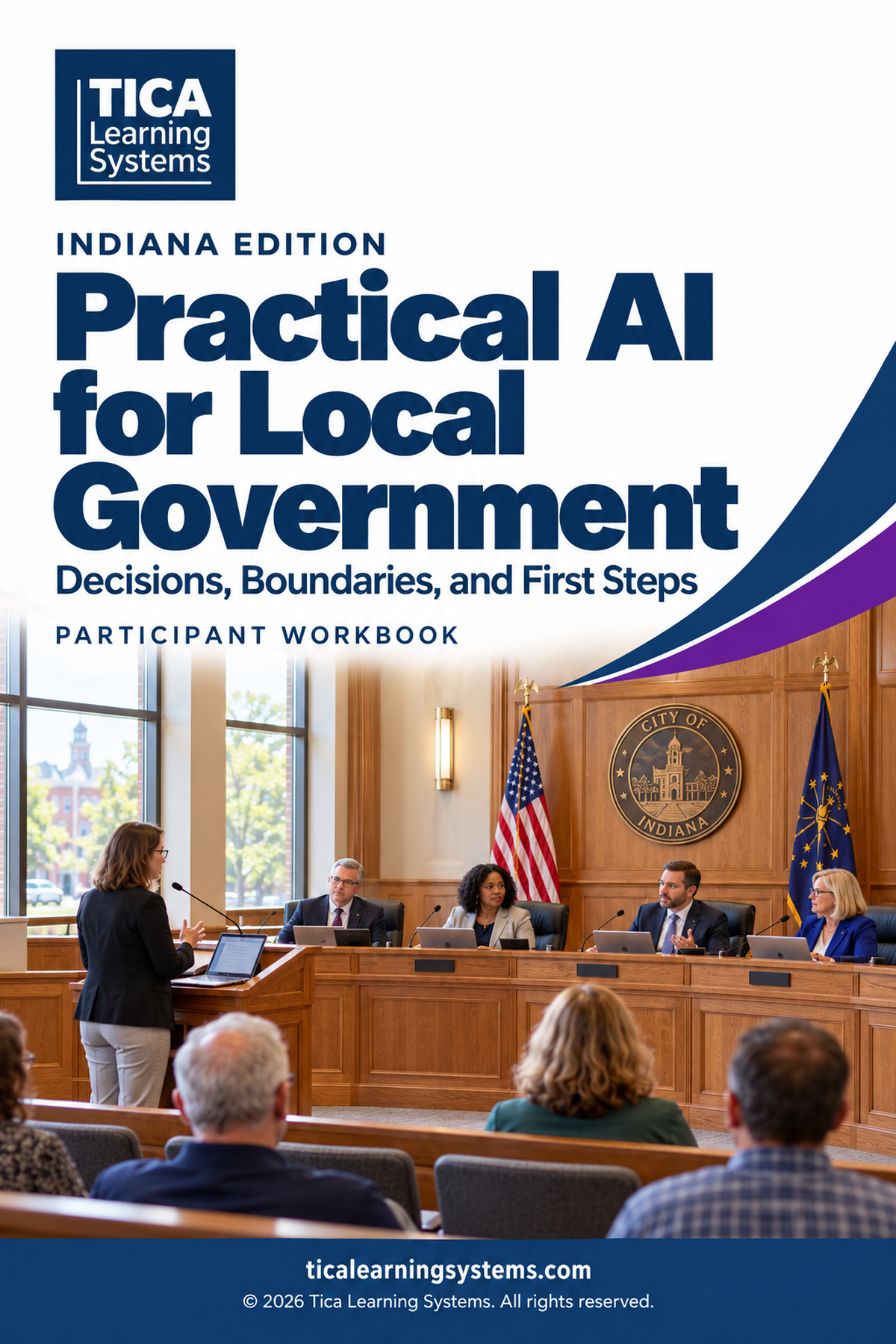
Practical AI for Local Government: Decisions, Boundaries, and First Steps
Indiana Edition | Fillable Participant Workbook
Give your office a practical process for deciding where AI fits, what information stays out, and who checks the work.
In a small local government office, the people considering AI are often the same people handling claims, preparing agendas, answering residents, and keeping daily operations moving. They need a clear way to evaluate its usefulness, establish boundaries, and maintain accountability.
This 40-page fillable workbook helps Indiana towns, small cities, and counties work through those decisions. It combines plain-language explanations, realistic fictional examples, hands-on exercises, and planning worksheets to help participants prepare a small, supervised AI pilot.
For local government teams and organizations that support them
The workbook is designed for clerk-treasurers, clerks, deputies, department heads, county officeholders, and elected officials, especially those working with limited technology support. It also supports participant learning in association programs, regional training sessions, and local government workshops.
Use it independently or as the participant workbook for a five-hour workshop. Organizational copies and workshop use require separate licensing.
What you’ll work through
- Groundwork: Resident expectations, accountability, AI system types, liability considerations, disclosure, cybersecurity readiness, and questions for vendors.
- Where AI fits: Evaluate everyday tasks and identify AI features already embedded in your office’s software.
- What stays out: Establish information boundaries and prepare questions for your attorney and records officer.
- Checking the work: Review AI drafts for factual errors, missing details, and changes in meaning before they reach the public.
- Who signs off: Map review and approval responsibilities within your town, city, or county.
- Planning a limited pilot: Define the task, tool, reviewer, measures, public explanation, and conditions for stopping.
Practice with three familiar office tasks
Draft a meeting agenda, review a plain-language public notice, and organize an internal procedure. Fictional Indiana examples give you material to practice with while keeping real resident and personnel information out of the exercises.
Tools you can use in your office
The workbook includes a task-sorting worksheet, cybersecurity readiness checklist, vendor security questions, information-sorting worksheet, public-facing draft review checklist, approval map, pilot plan, baseline and pilot time log, stop rules, public statement worksheet, and end-of-pilot review.
A specialist referral table helps you identify when to involve your attorney, records officer, fiscal officer, IT support, or insurer. A learning assessment is also included.
Your result
Work toward a written plan for a limited, supervised AI pilot that your governing body can review, with clear responsibilities and a method for assessing time savings and errors.
Format and use
Digital download: 40-page fillable PDF. Complete the fields electronically or print the workbook and write your responses.
The individual purchase licenses the workbook to one user. Reproduction, distribution, multiple participant copies, and workshop rights require written permission. For organizational licensing, visit ticalearningsystems.com/licensing.
This is the participant workbook. Facilitator materials and workshop delivery are separate offerings. Continuing education credit depends on approval for the specific training session and is not included with an individual workbook purchase.
Educational use only: This workbook supports learning and planning. It does not replace advice from your unit’s attorney, records officer, or technology specialists. Confirm current requirements and vendor terms before implementation.
© 2026 Tica Learning Systems, a dba of Minerva League Business Services, Inc.